
Material and product selection · 6 min read
Large Flour Squishies Wholesale: Material, Demo and Inventory Checks
Large flour squishies can create a strong display feature, but the word “large” does not tell a buyer how the item is filled, how quickly it rises, or how many units a carton holds. A sound wholesale brief starts with the TPR outer and flour filling, then checks the exact shape, package and shipping record. This guide keeps the product demonstration separate from the stock calculation.
Read a large flour squishy as a specific TPR-and-flour SKU, not as a generic size class. Confirm the listed dimensions and unit weight where available, request missing fields, and test the finished package in your display. Use fast-rise or slow-rise wording only when the catalog identifies it for that SKU. Treat carton quantity, gross weight and final pack-out as quote fields, especially for oversized shapes.
Start with the TPR-and-flour record
TPR describes the outer shell in the current large flour collection; flour describes the filling. Keep both fields in the purchase brief. This construction is different from a solid PU slow-rising foam product and from TPR styles filled with pectin, Vaseline or brick clay. Material language helps your team write an accurate listing, but it does not replace a sample check.
Ask for the final specification for the exact SKU you will buy. A collection page can contain multiple shapes and packaging formats. Do not transfer the weight, box type or rise description from one item to another because both are labeled large flour.
Separate size from rise wording
Size is a dimensional field. Rise wording describes a product behavior and should only be used when the catalog states it. Some records are simply marked flour filling; others identify fast-rise or slow-rise flour filling. If the field is not present, describe the material and size that are confirmed and leave the timing question for the sample or supplier confirmation.
Use a sample to approve the demonstration
Press the sample using the same method your staff or customer would use, then record the starting shape, handling feel and observed recovery. Keep the test note tied to the SKU and batch reference. A short video can show the interaction, but it should not become a promise about an exact recovery time unless that time has been documented for the product.
Compare current large flour records
The table shows why a buyer needs more than a “large” label. The first two entries include unit weight; the baguette record lists a size but its unit weight remains to be confirmed. This is useful purchasing information: a missing value is a question to send back, not a number to estimate.
| SKU and design | Listed size | Unit weight | Carton record | Buyer check |
|---|---|---|---|---|
| CS-LF-52 · Jumbo Lying Duck | 38 cm | 445 g | Carton quantity to be confirmed | Confirm inner pack and final carton count |
| CS-LF-53 · Yellow Duck | 26 cm | 211 g | 80 pcs/carton | 10 pcs/inner box × 8 boxes listed |
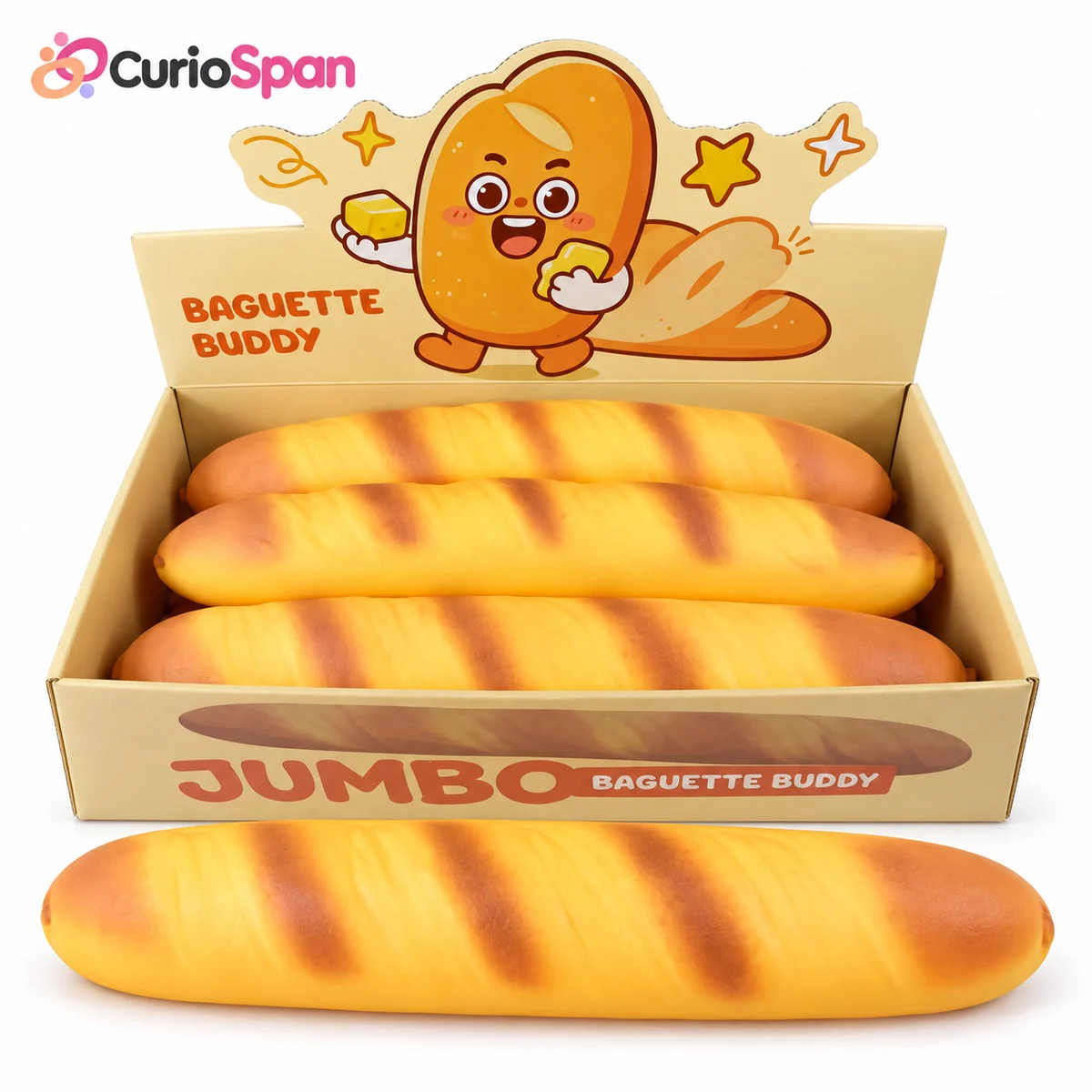
| CS-LF-10 · Baguette | 35 cm | To be confirmed | 48 pcs/carton | Request unit weight before freight planning |
All three records identify flour filling. The 38 cm duck lists PVC plus display box packaging and a 67 × 41 × 35 cm carton with 19.5 kg gross weight; the 26 cm duck lists an OPP bag plus display box and a 65 × 40 × 35 cm carton with 19.1 kg gross weight. Treat these as current catalog references and reconfirm them in the quote.
For a narrower shortlist, review the 17cm versus 20cm capybara comparison or the large fruit squishy size and packaging comparison. The butter squishy material comparison also includes flour-filled butter sticks alongside PU and crunchy options, so similar shapes remain tied to the correct construction.
Check display, storage and handling space
Place a packed sample in the actual shelf, bin or hanging area. Measure the package, not only the soft product. A long 35–38 cm shape may need horizontal shelf space, while a taller character can affect the sightline of neighboring products. Decide whether shoppers may handle the sample and whether replacement stock will stay behind the display.
For back-room planning, record units per inner box and master carton separately. The space calculation is a planning aid; it does not prove that cartons can be stacked in every orientation. Ask for carton orientation or handling limits when the shape is unusually long or soft.
Model order quantity without inventing missing fields
Use a simple worksheet with one line per SKU: requested pieces, listed carton quantity, unit weight, gross carton weight and missing fields. For example, a hypothetical request for 24 CS-LF-52 pieces is a quantity scenario only because its carton quantity is still to be confirmed. A request for 80 CS-LF-53 pieces matches the listed carton count, but you should still confirm that the quote uses the same packaging.
Do not calculate shipping from unit weight alone. Packaging, carton dimensions and the carrier’s method affect the final figure. If an oversized item has a missing unit weight or carton quantity, mark the freight estimate as provisional and ask the supplier to confirm the missing record before approval.
Approve the product copy with the package
Your product page should state the confirmed material, filling, size and pack-out, then point buyers to any quote-dependent fields. Use “fast-rise” or “slow-rise” only for records that say so. Avoid a universal recovery-time promise for the flour series when the catalog does not provide one.
Approve one photographed sample in its intended retail package. Check that the printed size, display image and actual item match. If a different box, bag or display count is proposed, update the SKU brief and request approval before production rather than allowing packaging changes to appear as a surprise at receiving.
Send a buyer-ready large flour brief
Choose exact lines in the large flour collection and include pieces per SKU, target display, destination and packaging preference. Ask for the confirmed unit weight, dimensions, inner pack, carton quantity, gross weight and any rise wording that should appear in the listing. If a field is already listed, ask the supplier to reconfirm it for the order rather than silently replacing it.
Use the spec-sheet guide to keep product data, packaging data and quote quantities separate. That record gives your team a repeatable path for reorders and makes it easier to explain why a large feature item needs a different stock plan from a compact counter style.
Buyer questions
Are all large flour squishies fast-rise or slow-rise?
No. The catalog includes flour records with no rise label as well as records that specify fast-rise or slow-rise flour filling. Use the wording only when it is stated for the exact SKU, and use a sample to approve the customer-facing demonstration.
Can I estimate freight from the listed unit weight?
Use unit weight as an early planning field only. Final freight needs the retail package, carton quantity, carton dimensions, gross weight and shipping method. Missing fields such as the CS-LF-52 carton quantity should be confirmed in the quote.
What should I check before buying a 35–38 cm flour squishy?
Confirm all three product dimensions, unit weight, finished package, display footprint, inner pack, carton quantity and gross weight. Test the sample in the intended fixture and approve product copy that matches the exact SKU.
Explore the catalog examples


Product examples use CurioSpan catalog information available on October 9, 2026. Planning examples are illustrative; confirm the selected SKU and order terms before purchasing.